Last updated on October 16th, 2026 at 03:57 pm
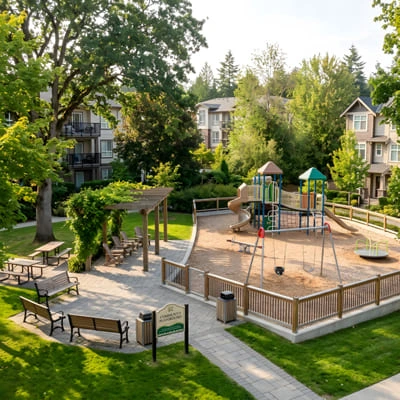
A well-designed kids backyard combines safe play surfaces, open space for movement, and a comfortable adult zone with a clear view of the play area. Divide the yard into zones, protect fall areas with tested surfacing, and add shade and seating so the whole family wants to stay outside.
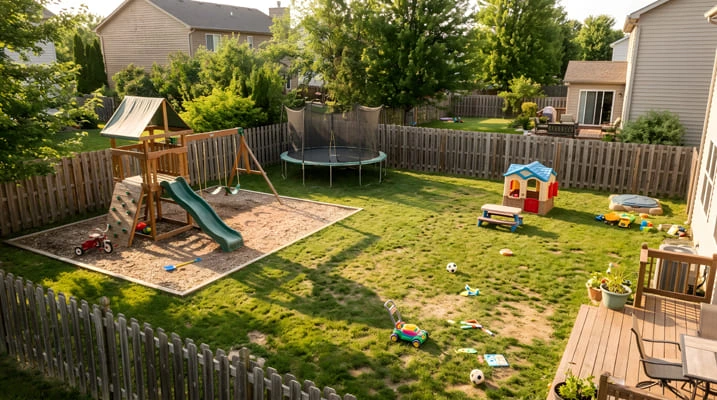
Most families know this scene. The kids drift toward screens, and the adults watch from the kitchen window. The yard sits empty, even though everyone says they want more time outdoors. A kids backyard that works for the whole family is not an accident. It is a design.
Research shows that design changes behavior. In a study of nearly 1,600 Australian preschoolers, each additional type of natural feature in the yard, such as a tree or flower bed, was linked to about five more minutes of outdoor play per day. Each additional fixed feature, such as a climbing frame or cubby house, was linked to about seven more minutes, according to findings summarized by Outdoor Play Canada. Better lawn quality added roughly eight minutes more.
Those gains look small one at a time. Together, they decide whether children play outside for twenty minutes or an hour. Adults respond to design in the same way. They stay out when there is shade, a place to sit, and a view of the children.
This guide shows you how to plan a kids backyard step by step. You will learn how to zone the space, choose safe surfaces, pick play features for each age, and make the yard comfortable for adults too.
Why a Kids Backyard Needs a Plan
A backyard without a plan tends to fill with random objects. A trampoline lands in the middle of the lawn. A swing set goes wherever it fits. The adult seating ends up in a corner that is hot, windy, or too far away to supervise anything.
The cost of that approach is real. Outdoor play matters for children’s development.
Dozens of studies have found that time outdoors, especially in free play, supports physical health, social skills, and even concentration and school readiness, according to a 2025 UNICEF overview of outdoor play.
The same source notes that children play outside less as they get older, even though older children and teenagers benefit just as much.
A plan helps in three ways:
- It increases use. Children play longer in yards with more features and better spaces.
- It reduces risk. Safe surfaces and clear sightlines prevent many injuries.
- It includes adults. When parents enjoy the space, they stay outside and supervise more easily.
Snippet: A kids backyard is a family yard designed around children’s play needs, with safe surfacing, varied play features, and adult seating placed within sight of the action. It treats play as a core use of the space, not an afterthought.
I start every family garden with one question: where will the adults sit? That answer shapes the rest. If parents have a comfortable spot with a clear view, the children get more freedom, and the whole yard gets more use.
Start With Zones: Designing a Kids Backyard Adults Also Enjoy
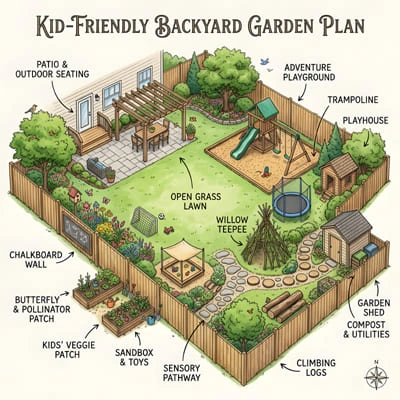
Zoning is the most useful tool for any family yard. It means dividing the space into areas with clear purposes. Each zone should serve one main activity, and a few should serve two.
| Zone | Kids Use | Adult Use | Placement Tip |
|---|---|---|---|
| Active play | Climbing, swinging, running | Supervising | Keep in direct sight of the house |
| Open lawn | Ball games, tag, picnics | Yoga, lounging, sports | Give it the sunniest, flattest area |
| Creative corner | Sandpit, mud kitchen, chalk wall | Coffee while watching | Place near seating and shade |
| Garden bed | Planting, digging, harvesting | Relaxation, herbs | Raise beds to protect plants |
| Social zone | Snacks, homework, board games | Dining, entertaining | Put close to the kitchen door |
| Retreat | Reading, hideouts, hammock | Quiet time | Tuck away with planting for privacy |
Some zones can overlap. A lawn can be a ball field in the afternoon and a picnic spot at dinner. A deck can hold a dining table and still look onto the sandpit. Overlap is what turns a kids backyard into a family backyard.
Plan the Flow
Think about how people move between zones. Children run. Adults carry trays. Wheelbarrows and scooters need paths. Keep main routes wide and clear. A looping path around the lawn gives children a track for bikes and scooters, and it keeps feet off your planting beds.
Protect the Sightlines
Parents supervise best when they can see the play area from where they sit. Stand at the kitchen window, the back door, and the seating area. Check what you can see from each point. Move tall shrubs, sheds, or screens that block the view. Low planting and open fencing keep the sightlines clean.
Quick tip: Put the play area where you can see it from the kitchen sink. Most parents spend more time there than anywhere else, and a clear view lets children play with more independence.
Safe Play Surfaces for a Kids Backyard
Surfacing is the most overlooked safety decision in a family yard. Falls cause most playground injuries, and the ground beneath the equipment decides how serious they are.
The numbers explain why this matters. About one in five playground injuries happens on a home playground.
About 80% of public playgrounds have protective surfacing, but only 9% of home playgrounds do, according to Consumer Product Safety Commission data summarized by North Dakota State University Extension.
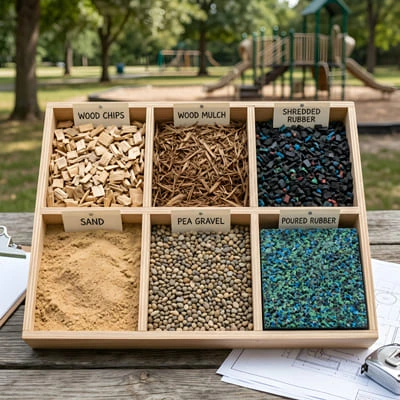
Here is how common materials compare. The depths below are minimum compressed depths, based on CPSC guidance for public playgrounds as summarized by the Illinois State Board of Education.
| Surface | Protects Up To | Minimum Compressed Depth | Upkeep | Notes |
|---|---|---|---|---|
| Wood chips | 10 ft | 9 in | Top up yearly | Natural look, affordable |
| Wood mulch (not CCA-treated) | 7 ft | 9 in | Top up yearly | Never use CCA-treated wood |
| Shredded rubber | 10 ft | 6 in | Low | Does not compress like wood |
| Sand | 4 ft | Per CPSC chart | Rake, cover when unused | Good for sandpits |
| Pea gravel | 5 ft | Per CPSC chart | Rake, refill | Can scatter and hide hazards |
| Poured rubber or mats | Varies by thickness | Per product test | Very low | Look for ASTM F1292 test data |
Snippet: Fall height is the distance from the highest surface a child can stand or sit on to the ground below. It determines how deep your protective surfacing must be, so measure it before choosing a material.
Rules for Safe Surfacing
- Measure fall height correctly. Use the highest platform where a child can stand, not the top of the frame.
- Cover the full use zone. Extend surfacing at least six feet around climbers and slides. For swings, extend it to twice the height of the pivot point.
- Install more than the minimum. Loose materials compact and break down over time, so start deeper and top up each year.
- Never place equipment on concrete or asphalt. Hard surfaces turn a minor fall into a serious injury.
- Check low equipment. Equipment with a fall height of 18 inches or less does not require protective surfacing, but a soft landing is still wise.
- Avoid CCA-treated wood mulch. Choose untreated wood or tested engineered wood fiber.
- Inspect every season. Rake, level, and refill as needed.
Always follow the manufacturer’s instructions and your local rules for any play equipment. These guidelines were written for public playgrounds, so treat them as a strong starting point for a home yard.
Play Features That Keep Kids Outside Longer
Children go where there is something to do. The best backyard play features mix fixed equipment, natural elements, and open-ended items.
Fixed Structures
Swings, climbers, slides, and playhouses give children a clear focus. The Australian study found that fixed equipment was a main factor in longer play. Researchers noted that a simple sandpit, swing, or cubby house can be enough, according to the University of Western Australia. You do not need a large play tower.
Natural Features
Trees, logs, boulders, mounds, and flower beds invite exploration. A low earth mound becomes a hill to roll down. A fallen log becomes a balance beam. Natural features also change with the seasons, which keeps the yard interesting.
Loose Parts
Landscape architects who design for children often point to loose parts as the one element that can transform any yard. These are movable items such as planks, crates, buckets, ropes, stones, and fabric. Children build, carry, and rearrange them. Loose parts work in a large yard or on a small patio, and they cost little.
Water, Sand, and Mud
Water and sand offer open-ended play for hours. A mud kitchen, a shallow water table, or a simple sandpit with a lid costs less than a large play set. Place them near adult seating so you can supervise easily.
Growing Things
A small vegetable bed or sunflower patch gives children a job and a reason to go outside. Raised beds at child height make it easy. Choose fast, reliable plants such as radishes, cherry tomatoes, and herbs.
Design for Each Age
Children’s needs change quickly. Plan so the yard can grow with them.
| Age Group | What They Want | Design Ideas |
|---|---|---|
| Toddlers (1–3) | Safe exploration, sensory play | Low sandpit, soft surfacing, fenced zone, sensory plants |
| Preschool (3–5) | Imaginative play, climbing | Cubby house, mud kitchen, low climber, tricycle loop |
| School age (6–11) | Challenge, games, building | Rope climber, loose parts, open lawn, den-building spot |
| Tweens and teens | Space, privacy, hangouts | Hammock, outdoor seating, ball hoop, string lights |
Older children are the group most often forgotten. A hammock, a bench circle, or a simple projector wall gives teenagers a reason to stay out with the family.
A yard that only serves children will not hold adults for long. Adults need comfort, shade, and a reason to sit down.
Making a Kids Backyard Work for Adults
Shade and Shelter
Sun exposure matters for children and adults alike. Plan shade for both the play area and the seating area. A pergola, a shade sail, or a large deciduous tree can do the job. Shade also makes the yard usable during the hottest hours, which extends play time through the day.
Seating and Dining
Place seating where it has a clear view of the play area. A bench along the edge of the sandpit works well. A table near the kitchen door makes snacks and meals easy. Choose weather-resistant furniture that can handle spills and sun.
Storage
Toys scatter fast. A storage bench, a lidded box, or a small shed keeps the yard tidy. When cleanup takes thirty seconds, adults are more willing to use the space.
Plants for Families
Choose plants that can handle running feet and curious hands. Avoid thorns near play areas. Check any new plant before you buy it, because some common garden plants are toxic if eaten. Sturdy shrubs, ornamental grasses, and herbs hold up well. A hardy lawn or a path of stepping stones takes heavy traffic better than delicate planting.
Lighting and Evenings
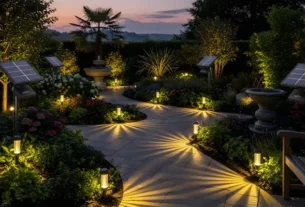
Soft outdoor lighting extends the day. String lights, path lights, and a few warm lanterns make the yard feel inviting after dinner. This turns the backyard into a place adults want to be at dusk, not just a place to supervise.
Quiet Moments
Include one spot that is just for adults. It might be a corner with two chairs and a small table. It might be a hammock behind a screen of planting. A small retreat makes it easier for parents to enjoy the yard without feeling on duty.
Quick tip: Make the adult zone as attractive as the play zone. If parents love sitting there, the family will use the whole yard more often.
Common Mistakes When Designing a Kids Backyard
A few mistakes appear again and again.
- Skipping protective surfacing, which is the most common and most serious safety gap.
- Placing equipment where adults cannot see it, which limits supervision and independence.
- Buying large equipment for the wrong age, since children outgrow play sets quickly.
- Forgetting shade, so the play area is too hot to use at midday.
- Ignoring adult comfort, which leaves parents indoors.
- Using toxic or thorny plants near play areas, which creates avoidable risks.
- Planting delicate beds along the main running routes, where they get trampled.
- Overbuilding at the start, when a few flexible features can do more.
The fix is usually simple. Plan the zones first, choose surfacing before equipment, and add features gradually as you see how your family uses the space.
Building a Yard the Whole Family Uses
A good kids backyard is built on a few clear decisions. Divide the space into zones, protect play areas with properly sized surfacing, and choose features that suit your children’s ages.
Then make the adult spaces just as inviting, with shade, seating, and a view of the play area. Start with sightlines and surfacing this month, and add loose parts and natural features as you go. If you have redesigned your own yard for the family, tell me in the comments which change made the biggest difference.
Important Notice: The information in this article is for informational and educational purposes only and is not a substitute for the evaluation or guidance of a healthcare professional. Always consult a doctor before making any decisions regarding your treatment or diagnosis.

Architect with extensive experience in residential and commercial design, including renovations and modular construction. Love to share information about Architecture, home and lifestyle in this blog.