Last updated on November 2nd, 2026 at 06:26 pm
Campervan living becomes comfortable when you plan the space around your daily routines, not just the layout. Prioritize a proper bed, reliable power, ventilation, safe gas and heating, and smart storage. Then add soft lighting and personal touches. Comfort comes from good systems and habits, not from square footage.
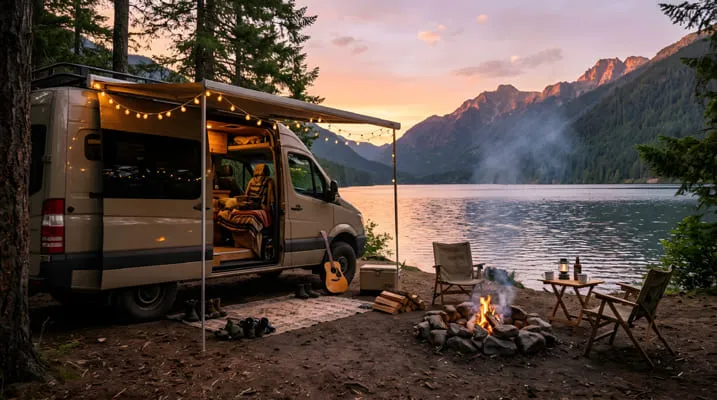
The photos make campervan living look effortless: a golden sunrise, a mug of coffee, an open sliding door. The reality includes a damp window at 6 a.m., a flat battery on day three, and a pile of gear on the bed. Comfort does not arrive with the van. You design it.
Interest in this lifestyle has grown fast. Bankrate, citing Statista, reports that the number of American van lifers rose from 1.9 million in 2020 to 3.1 million in 2022.
That figure comes from a survey of US adults and is the most recent widely cited number I found, so treat it as a snapshot, not a census.
It still shows how many people ask the same question: how do you make a small metal box feel like home?
As an architect, I read a van the way I read any small dwelling. I look at the site, the climate, and the people who will live in it. This guide rests on three pillars: space, systems, and routines. Space is how you arrange the interior. Systems are power, water, heat, and air. Routines are the daily habits that decide whether a layout works. Get all three right and a few square meters can feel generous.
What Campervan Living Really Looks Like
What is campervan living? Campervan living means using a converted or purpose-built van as a main or frequent home, with a bed, a cooking area, storage, and power on board. People do it full time, seasonally, or on long trips.
The lifestyle covers a wide range. Some people live in a van for a year while they work remotely. Others spend three months a year on the road and return to a house. Retirees, couples, solo travelers, and families all appear in the mix.
Your pattern of use should drive every design decision. A weekend traveler needs a quick-folding bed. A full-time resident needs real storage and a reliable climate system.
| Use pattern | Typical setup | Biggest design priority |
|---|---|---|
| Weekend trips | Folding bed, portable stove, basic storage | Fast setup and easy packing |
| Seasonal travel | Fixed bed, fridge, small battery system | Comfort in one climate |
| Full-time living | Full kitchen, larger battery, water tank, heater | Storage, ventilation, and durability |
| Remote work on the road | Desk surface, strong battery, mobile data | Power budget and a usable workspace |
What It Costs
Money shapes the whole project, so it helps to look at real numbers. According to the same Bankrate breakdown, a DIY conversion starts at a little over $2,000, while professional conversions start around $30,000 before you buy the van. Roughly 80 percent of van lifers do their own conversions. Current van lifers spend about $1,000 to $3,000 a month.
That range challenges a common myth. Living in a van can cost less than renting, but it is not automatically cheap. Fuel, insurance, repairs, data plans, and showers all add up. Budget for the lifestyle you will actually live, not the one in the photos.
Read Your Situation Honestly
Before you buy a single cabinet, answer four questions. Where will you spend most of your time, and in which climate? How many people will sleep inside? Will you work from the van? How long will you stay in one place?
Honest answers prevent expensive mistakes. A van built for a mild coast needs very different insulation from one built for mountain winters. This is the same principle I apply to every building: read the site first, then design.
Space: Design a Layout That Works Every Day
A campervan is a house with no spare room. Every square meter has to earn its place, so I divide the interior into zones: sleeping, cooking, sitting or working, storage, and hygiene. Then I ask which zones can share the same floor area at different times of day.
The most useful trick is a flexible zone. A bed that becomes a sofa, or a table that folds away, gives you two rooms in one. It also protects you from a layout that feels fine on day one and cramped by week three.
Choose Your Bed First
The bed is the largest piece of furniture, so it sets the plan. Sleep is also where comfort matters most. A poor bed ruins the lifestyle faster than any other flaw.
| Bed type | Setup effort | Storage potential | Best for |
|---|---|---|---|
| Fixed rear bed | None | High storage underneath | Full-time living and couples |
| Convertible dinette or sofa bed | Daily conversion | Moderate | Short trips and flexible seating |
| Pop-top or upper bed | Raise and lower | Keeps the main floor open | Compact vans and families |
| Transverse (across the van) bed | None | Good, with a garage underneath | Longer vans with a rear door |
A fixed bed with a “garage” underneath suits most full-time residents. You trade some daytime floor space for storage that stays organized.
Storage That Actually Works
Storage fails when it is hard to reach. Give everything a home, and put the things you use daily where you can grab them without moving anything else.
Weight matters as much as volume. Every liter of water weighs one kilogram, so a 50-liter tank adds 50 kilograms before you pack a single bag.
Keep heavy items low and close to the axles, and check your van’s payload limit, which is the maximum load the manufacturer allows.
Overloading affects handling, braking, and insurance.
Use vertical space. Hooks, overhead cabinets, and wall-mounted rails hold a surprising amount. A good rule is “one in, one out”: when something new comes aboard, something else leaves.
A Simple Example
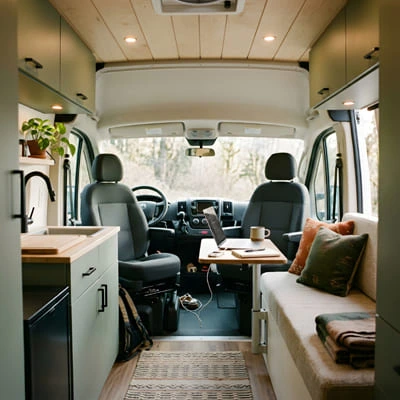
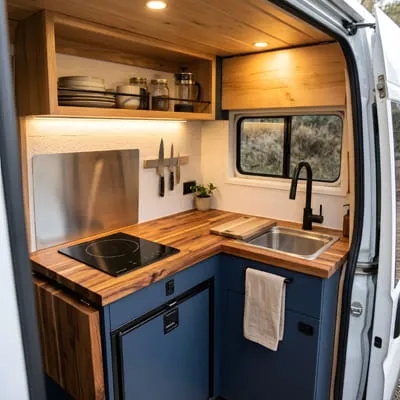
Picture a couple who both work online in a 5.4-meter van. A fixed rear bed with storage underneath handles sleeping and gear. A swivel passenger seat and a folding table create a shared desk. The kitchen sits beside the sliding door, so cooking fumes leave quickly and the window stays open. Nothing is complicated, but every piece does two jobs.
Systems: Power, Water, Heat, and Air
Systems are invisible when they work and unbearable when they fail. They are also where small design choices have the biggest impact on comfort.
Power: Estimate Before You Buy
Start with a simple formula: watts multiplied by hours equals watt-hours (Wh). Add up what you use in a day, then size the battery to match with a margin. The figures below are illustrative. Check the labels on your own appliances.
| Appliance | Power draw | Daily use | Approx. daily Wh |
|---|---|---|---|
| 12V compressor fridge (average) | 20 W | 24 hours | 480 |
| Laptop | 60 W | 6 hours | 360 |
| LED lighting | 10 W | 5 hours | 50 |
| Ventilation fan | 10 W | 6 hours | 60 |
| Phone and small device charging | 30 W | 1 hour | 30 |
| Total | about 980 Wh |
A 100 Ah lithium battery at 12.8 volts stores roughly 1,280 Wh. That covers this example with a small reserve. I would add 20 to 30 percent of margin for cloudy days and battery aging. Many builders choose lithium iron phosphate batteries for their weight and cycle life, and charge them from solar panels, the engine through a DC-DC charger, or shore power.
Hire a qualified installer for high-current wiring. Correct fuses and cable sizing prevent fires.
Water: Plan for Real Use
Water storage is a balance between weight and convenience. My planning figure is around 10 liters per person per day for drinking, cooking, and light washing. Showers use more, which is why many people use gyms, campsites, or outdoor solar showers.
Keep the tank accessible for cleaning, and carry a way to purify water you collect from unknown sources.
Insulation, Ventilation, and Condensation
Metal is a poor insulator, and people add a lot of moisture to a small space. Breathing, cooking, and drying wet clothes all release water vapor. When that vapor meets a cold metal surface, it condenses.
How do you stop condensation in a campervan? Insulate cold metal surfaces, ventilate while you cook and sleep, and keep wet items out of the living area. A roof fan clears moist air faster than an open window alone.
Continuous insulation matters more than thick insulation in a few spots. Gaps create cold bridges, which are the places where condensation collects first. Ventilation is the other half of the answer. A roof vent with a fan and a slightly open window create airflow without losing much warmth.
Heating and Cooling
Heating deserves care, because the wrong choice is dangerous. The table compares common options.
| Heater type | Strengths | Cautions |
|---|---|---|
| Diesel air heater | Efficient, uses the van’s fuel, vents outside | Needs correct installation and an external exhaust |
| LPG room-sealed heater | Strong output, common in factory vans | Needs gas safety checks and ventilation |
| Electric heater (hook-up) | Simple and clean | Needs campsite power |
| Portable gas heater | Cheap and widely sold | Not safe for indoor use in a van |
For cooling, reduce the heat before it enters. Reflective window covers, shade parking, and a good fan make a large difference. Light-colored roofs also help.
Safety First: Gas, Carbon Monoxide, Fire, and Security
Safety is the least glamorous part of the build and the most important. Combustion gives off carbon monoxide (CO), a gas you cannot see, smell, or taste.
The UK’s National Caravan Council (NCC) issued a warning after two people died of CO poisoning linked to a gas cylinder heater used inside a campervan. The NCC states that portable gas heaters designed for outdoor use must never be used inside a campervan or any enclosed space. It adds that the ventilation in a conversion is not designed to make such heaters safe. It also recommends regularly testing your CO alarm.
The US National Fire Protection Association gives similar advice. Its motor home and camper guidance recommends working smoke and CO alarms, a gas leak detector, and periodic inspection of the propane system. It also advises staying in the kitchen while you cook.
A Safety Checklist
- Install a CO alarm rated for vehicles, near the sleeping area, and test it on a schedule.
- Fit a smoke alarm designed for campervans, not a standard household unit.
- Add a gas leak detector if you use LPG, mounted low where heavy gas settles.
- Carry a fire extinguisher and a fire blanket within reach of the exit.
- Have the gas system inspected by a qualified technician before the first trip and at regular intervals.
- Check your ventilation every time you cook or run a heater.
Architect’s tip: Check the flame on your gas stove. A steady blue flame suggests good combustion. A flame that stays yellow means something is wrong, so turn the appliance off and have it checked.
Personal Security
Security is mostly about habits. Keep your keys where you can reach them from bed. Use curtains or blackout covers so people cannot see in. Choose parking spots with other vehicles or lights nearby, and move on if a place feels wrong. Your instincts are a valid safety system.
Routines: Cooking, Hygiene, Work, and Where to Park
A layout only works if your daily routine fits it. This pillar is the one most people overlook, because it only shows up after you start living in the van.
Cooking in a Small Space
Cook simply. One-pot meals, a good knife, and a single pan cover most needs. Prepare food outside when the weather allows, which keeps moisture and smells out of your living space. Open a window or vent whenever the stove is on.
A compact fridge changes the lifestyle. Fresh food lets you cook real meals, and that supports both budget and health.
Hygiene and Laundry
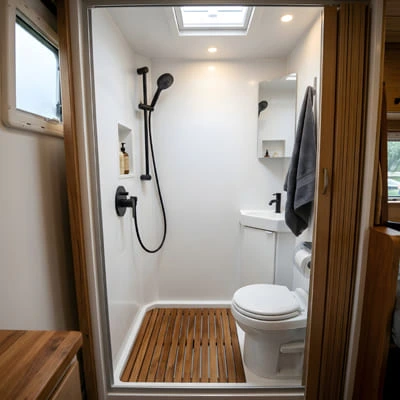
Plan for showers and laundry before you leave. Gyms, campsites, and public facilities fill the gap for many people. Others install a small shower or use a portable outdoor unit. Wet towels create moisture, so dry them outside whenever you can.
Toilets deserve an early decision. Options include cassette toilets, composting toilets, and a plan to use public facilities. Each has trade-offs in cost, space, and maintenance.
Working and Staying Connected
Remote work in a van depends on three things: power, signal, and a comfortable workspace. Use your energy budget to decide how many hours you can work off the battery. A mobile data plan with a backup option and a signal booster help in weak areas. Schedule heavy work for days with sun or shore power.
Where You Can Legally Park and Sleep
Parking is the biggest practical limit. Rules differ by country, state, and even town, so research before you arrive.
In the United States, the Bureau of Land Management (BLM) allows camping on much of its land. Dispersed camping is generally limited to 14 days within any 28-day period, and BLM states it is for short-term recreation, not long-term living. The BLM also asks campers to stay at least 200 feet from lakes, rivers, and streams. Limits vary by field office, so check locally.
Other countries have their own systems, from designated overnight stopping areas to strict bans outside campsites. Respect local signs, leave no trace, and keep noise low. Popularity has led some places to restrict overnight parking, and good behavior helps keep other spots open.
Making Campervan Living Feel Like Home
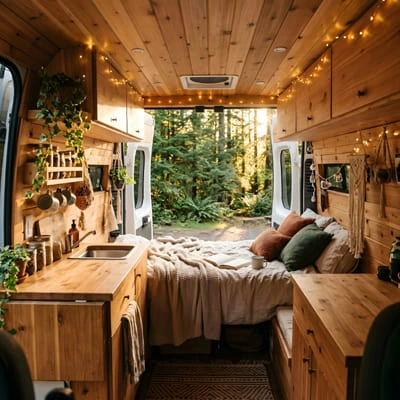
Comfort is more than systems. A home needs warmth, personality, and a sense of calm. In a small space, a few careful choices do the work of an entire room.
Lighting makes the biggest difference. Overhead lights flatten a small interior. Layer warm lighting instead: dimmable LED strips, a reading light by the bed, and one soft lamp in the sitting area.
Warm tones around 2700K feel closer to a house than cool white does.
Color and texture come next. Light, warm colors make a small interior feel open.
Natural materials, such as wood, linen, and wool, add depth without clutter. Keep the palette to two or three colors so the space feels calm.
Low-Cost Comfort Upgrades
These changes cost little and improve daily life quickly:
- Blackout window covers for sleep, privacy, and temperature control
- A quality mattress or topper sized for the bed
- Warm, dimmable lighting in each zone
- Hooks and rails that keep daily items off surfaces
- An outdoor mat and folding chairs that extend your living area through the door
- A few personal objects, such as a photo, a small plant, or a favorite mug
That last point matters. Authenticity is what makes a place feel like yours. Keep the things that carry meaning and let the rest go. A van that reflects how you actually live will always feel more comfortable than one copied from a photo.
Campervan Living, Done Comfortably
Comfortable campervan living comes from three pillars working together. Space gives you a layout built around real zones and flexible furniture. Systems keep power, water, heat, and air reliable and safe.
Routines make the whole design fit the way you actually live.
Start with honest answers about your climate, your budget, and your daily habits.
Build safety in from the first day, then add light, texture, and personal touches until the van feels like yours.
Have you built or planned a van of your own? Share your best comfort tip in the comments, and explore more lifestyle guides on the blog for ideas on small spaces and intentional living.
Important Notice
Finance: The information presented here is for educational purposes only and does not constitute investment advice. Consult a licensed financial professional before making any financial decisions.
Legal: This article is for informational purposes only and is not a substitute for specialized legal advice. Consult an attorney for guidance specific to your case. Rules on overnight parking, vehicle registration, and conversions vary by location, so confirm local requirements.
Safety: The safety information in this article is general guidance. Have gas and electrical systems installed and inspected by qualified professionals.Intentional Living: The Complete Guide to Slow Living, Small Homes, and Designing a Life That Fits You

Architect with extensive experience in residential and commercial design, including renovations and modular construction. Love to share information about Architecture, home and lifestyle in this blog.